
Startup India Registration Registration
Fast Processing
Startup India is a flagship initiative of the Government of India, launched on 16th January 2016, to build a strong ecosystem for nurturing innovation and startups in India. The scheme is administered by the Department for Promotion of Industry and Internal Trade (DPIIT).
DPIIT Recognition, Benefits, Required Documents & Step-by-Step Process
Startup India is a flagship initiative of the Government of India, launched on 16th January 2016, to build a strong ecosystem for nurturing innovation and startups in India. The scheme is administered by the Department for Promotion of Industry and Internal Trade (DPIIT).
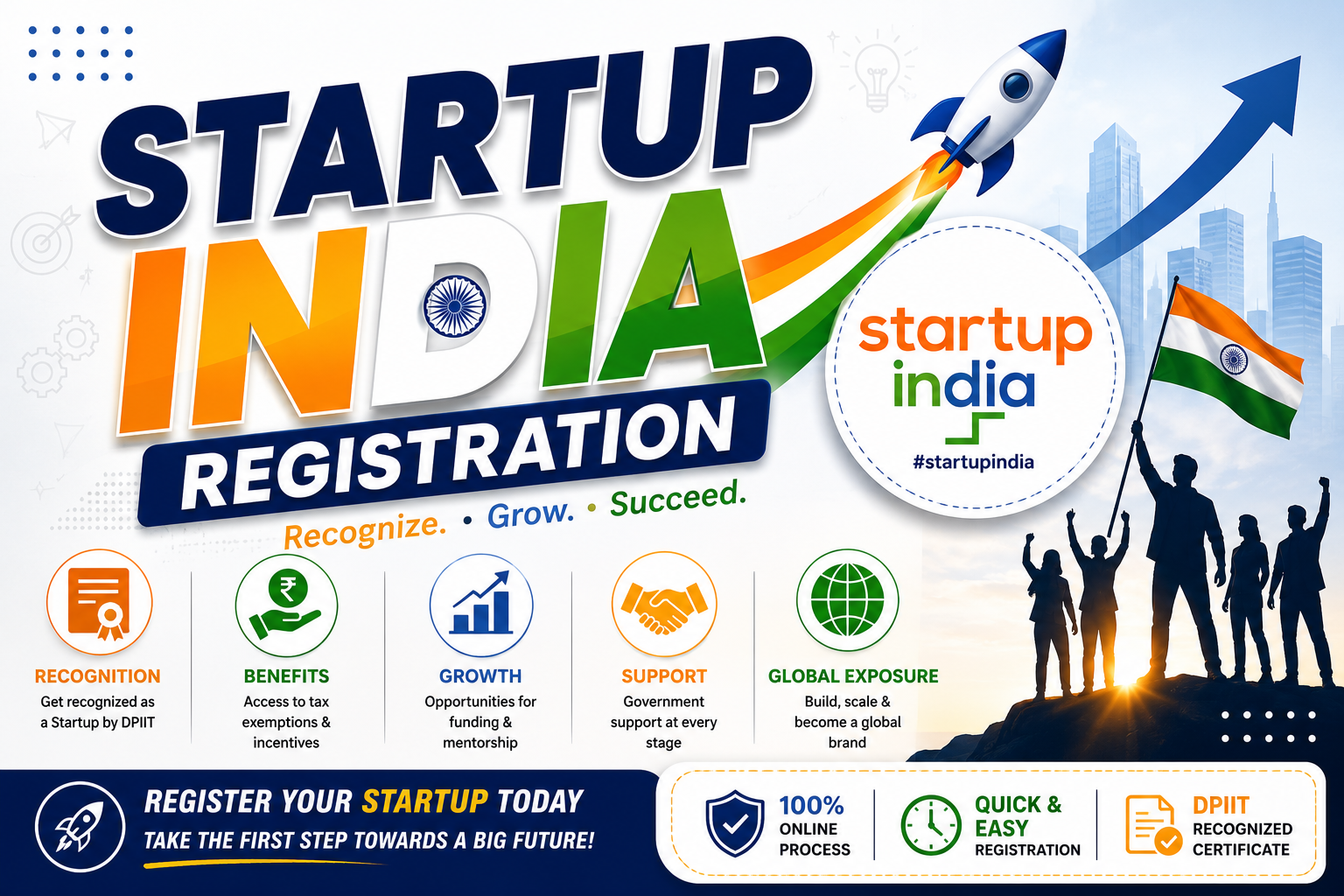
Recognition under Startup India unlocks a wide array of tax benefits, regulatory relaxations, and funding support, helping entrepreneurs grow their ventures rapidly with lower friction and compliance costs.
An entity is recognized as a 'Startup' by DPIIT only if ALL of the following conditions are met simultaneously:
All documents are uploaded online on the Startup India portal (www.startupindia.gov.in). Physical submission is not required. Documents must be in PDF format unless otherwise specified.
Incorporate a Private Limited Company (via MCA SPICe+ form), register an LLP (via LLP-FiLLiP form), or register a Partnership Firm with the Registrar of Firms. Ensure the entity is within 10 years old and turnover has not exceeded Rs. 100 crore in any financial year.
Visit the official website (www.startupindia.gov.in), click 'Register', select the entity type as 'Startup', enter credentials, and verify your email and mobile via OTP to access your dashboard.
Navigate to 'Apply for DPIIT Recognition' and complete the online application across Entity details, Sector info, Revenue/Funding profiles, and Intellectual Property tracking.
Upload the Certificate of Incorporation/Registration, a 2-page write-up or dynamic pitch deck, and optional proofs like MVPs, awards, or IP filings. All files must be in clear, readable PDF formats under 2 MB each.
Provide self-declarations confirming the criteria matches, all details are authentic, and the structure is not formed via a split-up. Hit 'Submit Application'. The process is entirely online and completely free of cost with zero hidden application fees.
DPIIT reviews the electronic submission. Complete files are approved quickly, usually in 2–7 working days. If any discrepancies or queries are highlighted, you must revert inside a 30-day window. On final approval, a permanent digital Certificate of Recognition with a unique DPIIT number is issued.
After gaining your core certificate, submit separate applications to the Inter-Ministerial Board (IMB) on the platform for Section 80-IAC tax incentives, file for Angel Tax exemptions via Form 2, or communicate with the IP registries using your unique code to leverage fast-tracked IPR processing.
Expert technical answers regarding Startup India rules and processes
Q: Can a sole proprietorship or a company older than 10 years apply for Startup India recognition?
Ans. No. Sole proprietorships and HUFs are not eligible. The entity must be structured as a Private Limited Company, LLP, or Registered Partnership Firm. Additionally, an entity older than 10 years cannot apply as it fails the age constraint, regardless of how innovative the core model is.
Q: Is there any registration fee for DPIIT recognition under Startup India?
Ans. No. The entire registration setup on the portal is completely free of cost. There are no application fees, administrative handling costs, processing fees, or renewal fees involved. The digital certificate is granted without any charges.
Q: What is the difference between DPIIT Recognition and IMB Approval for income tax exemption?
Ans. DPIIT Recognition is the primary foundation level that unlocks major perks like Angel Tax exemptions, regulatory self-certifications, procurement entries, and IPR rebates. On the other hand, Inter-Ministerial Board (IMB) Approval is an advanced, secondary step required exclusively to claim the 3-year income tax holiday under Section 80-IAC. Not every DPIIT-recognized firm needs or obtains IMB clearance.
Q: What does 'innovation' mean for the purpose of DPIIT recognition? Can a retail shop apply?
Ans. DPIIT requires showing innovation/development of a new or significantly improved product/process/service, or running a scalable business model with high employment or wealth generation potential. A conventional retail shop merely trading existing items without structural innovation, proprietary technology, or true scalability will not qualify.
Q: Can a DPIIT-recognized startup avail of both the angel tax exemption and the Section 80-IAC tax holiday simultaneously?
Ans. Yes. Both benefits are available concurrently but follow distinct tracks. Angel Tax benefits apply automatically with DPIIT recognition (up to the Rs. 25 crore threshold), whereas the 80-IAC tax holiday demands an independent application to the IMB. A startup might obtain one without securing the other.
Q: How long is the DPIIT Certificate of Recognition valid?
Ans. The certificate carries no fixed expiration dates. It remains active as long as the underlying entity complies with core criteria: maintaining an age of less than 10 years and keeping its individual financial year turnovers below Rs. 100 crore. If either boundary is broken, the recognition terminates or is revoked.
Q: Can a startup that has received foreign investment (FDI) apply for DPIIT recognition?
Ans. Yes, foreign investment forms no restriction for obtaining a DPIIT certificate. Entities with partial or major foreign holdings can apply freely, provided they are locally incorporated in India as Private Limited Companies, LLPs, or Partnership structures and fulfill standard validation rules.
Q: What is the 80% rebate on patent filing, and how is it availed?
Ans. Startups get an 80% fee reduction on patent filing. To access this, provide your valid DPIIT registration number to the Indian Patent Office (IPO) at the time of submission. DPIIT also assigns legal facilitators to handle drafting and filings at no professional cost, and applications are pushed through an expedited examination line.
Q: Can a startup apply if it is in the ideation stage with no revenue or product?
Ans. Yes. Ideation-stage companies with zero revenue or active products are eligible to apply. However, because there is no market traction data, the innovation statements must explicitly and logically present the target problem, the uniqueness of your concept, and its scalability mechanics. A solid pitch deck is highly recommended here.
Q: What happens if the startup's turnover crosses Rs. 100 crore after recognition?
Ans. If annual revenues breach Rs. 100 crore, eligibility criteria are officially compromised. The firm must notify the DPIIT, and startup recognition will cease. Notably, previous tax advantages claimed during valid operational cycles are not clawed back retroactively; only prospective startup-specific benefits are terminated.
Q: Can a startup change its business model after getting DPIIT recognition?
Ans. Pivoting or expanding your workflow is allowed, but the newly adjusted business architecture must still satisfy innovation and scalability frameworks. Pivoting completely into simple trading or conventional manufacturing tracks without high-tech or unique elements triggers review and potential cancellation of status.
Q: Can a registered startup be wound up easily if the business fails?
Ans. Yes. DPIIT-recognized companies and LLPs benefit from an accelerated fast-track exit configuration under the Insolvency and Bankruptcy Code, 2016. This scheme permits complete formal winding up inside a fast 90-day window from application filing, providing a seamless runway compared to typical multi-year corporate closures.
With expert Professional support